
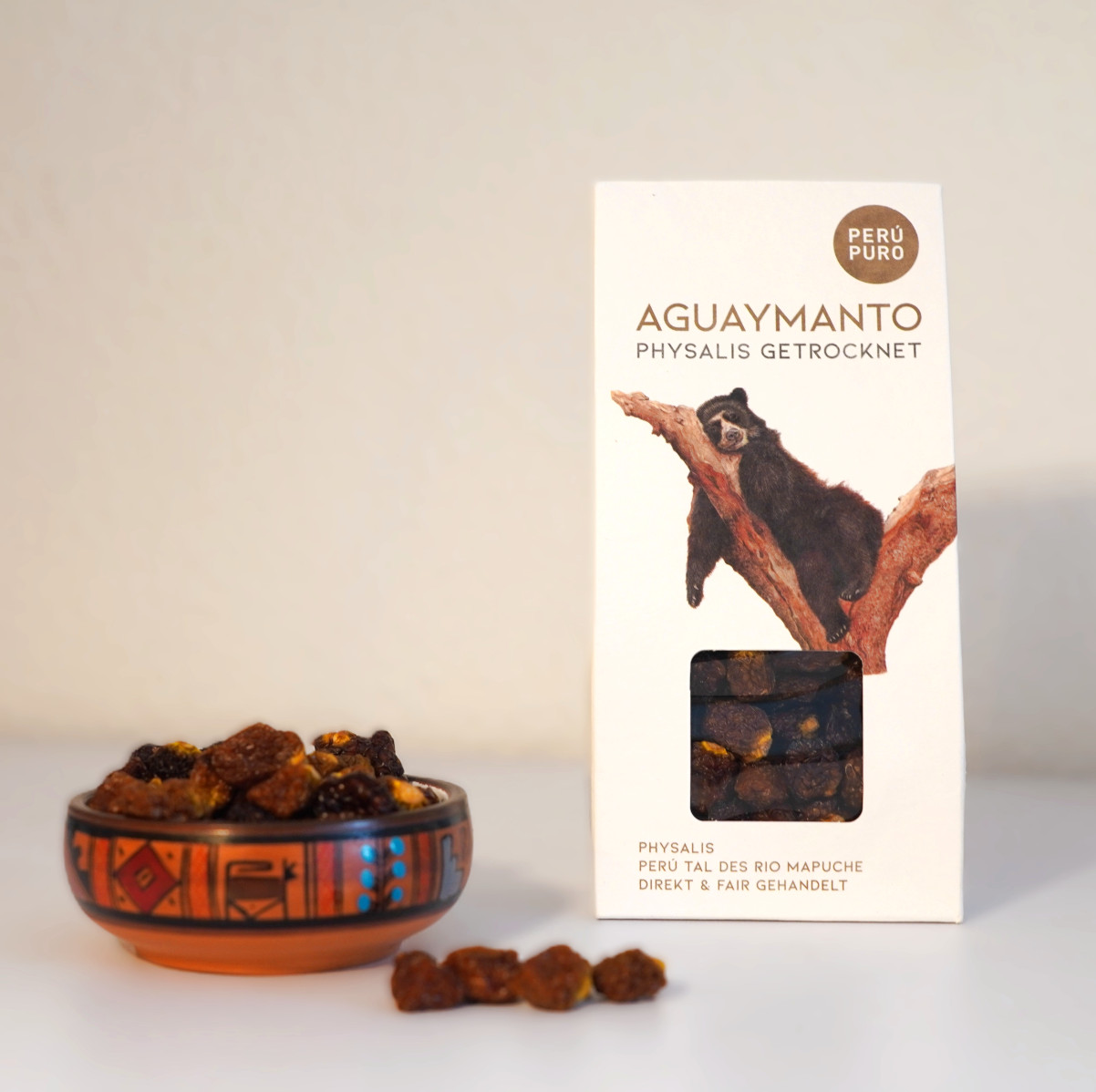
Physalis, dried (100 g)
6,90 € inkl. MwSt.
69,00 € / kg
incl. 7% VAT
excl. shipping costs
Availability: In stock
Why Physalis?
Physalis peruvianus is also known as the Andean berry, Andean cherry, or Cape gooseberry, but in Peru it is called aguaymanto . It is native to the South American Andean highlands, where native varieties are still cultivated today.
Physalis is also a true superfood: This aromatic berry is packed with vitamins A, B1, B2, B3, and C, antioxidants, potassium, iron, and other trace minerals.
With their incomparably fruity, tart, and sweet flavor, they’re perfect for snacking or for spicing up your morning cereal.
How our Physalis are saving bears.
The residents of the Mapuche Valley, located on the Andean highland border of Manu National Park, have traditionally relied primarily on corn farming for their livelihood. Because the Andean bear is considered a crop thief and pest in cornfields, animals are repeatedly killed illegally. Incidentally, this corn is often not eaten at all, but sold (at low prices) to conventional poultry producers.
As part of a project by the Zoological Society (ZGF), the affected farming families are enrolled in a training program. There, they learn about the unique characteristics of the Andean bear, the threats it faces, and the fact that it is often rats—not Andean bears—that eat the corn. The program also promotes the space-saving and ecological cultivation of the native aguaymanto (Physalis peruviana, also known as the Andean berry or Cape gooseberry). Andean bears do not like aguaymanto and avoid areas near people—and thus the fields where Physalis is grown near the villages.
By purchasing the fruit directly from the families, we provide them with a sustainable and economically attractive alternative to growing feed corn. Not only do farming families earn more money by growing physalis, but the physalis is also better protected from herbivores. This, in turn, helps protect the Andean bear from persecution.
How we grow:
Our physalis are grown organically and without pesticides—verified on-site and through laboratory analyses.
They are then harvested at the perfect stage of ripeness. At temperatures below 40°C, moisture is gently removed using a dehydrator. This preserves the valuable nutrients.
The Physalis farmers are NOT yet certified organic. However, they operate in accordance with the guidelines and are in the three-year transition period to obtain certification.
| Weight | 0,1 kg |
|---|---|
| Dimensions | 5 × 8 × 1 cm |
| Marke | PERÚ PURO |
| GTIN | 0 705632 479698 |
Related products
-
Organic cocoa nibs, roasted, made from Chuncho heirloom cocoa (100g)
6,90 € inkl. MwSt.6,90 € / 100 g
Add to cart -
Chuncho Gold Grand Cru 70% (70 g), 2025 Vintage, Organic Fine Chocolate
9,90 € inkl. MwSt.141,43 € / kg
Add to cart -
Organic Cocoa Tea Made from Chuncho, the Original Cocoa (70g)
6,90 € inkl. MwSt.9,86 € / 100 g
Add to cart

